
Same-contour phrase pairs
This technique is called "sequence": a melodic phrase is repeated at a higher or lower pitch. It's a fairly common device in pop and classical music, and it's an essential part of Billy Joel's symmetrical songwriting sensibility.

Usually a phrase's reiteration is embellished in some way, so its contour is not perfectly identical, but it's still closely-related at structural points.
He used it most often in the '70s, peaking on The Stranger album.
Syncopated 3-note rhythm
Several Billy Joel songs from the mid-'70s contain a similar rhythmic pattern: he sings a dense sequence of sixteenth or eighth notes, with a note onset on all subdivisions but the first in each group of four.




I see critics compare me to Elton John, I see Harry Chapin, and I go 'No, no, it's McCartney.'
— Billy Joel, New York Times interview (1978)
Points of connection
- Both songs are in the key of A and share a single rhythmically-identical pentatonic melody line (highlighted)
- Phonetically similar lyrics in the same rhythmic positions ("thought I knew"/"think I need", "an[swer]"/"an[ything]")

From early on, I felt Beethoven. I still think he is the greatest composer who ever lived.
— Billy Joel, interview in Far Out Magazine (2025)
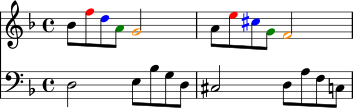

The sequence [that opens the chorus of Movin' Out] is heard untransposed [...] in the F-major Sonatina ascribed by Thayer to Beethoven's Bonn period (first movement, mm. 35-38).
— Walter Everett, 2000. "The Learned vs. The Vernacular in the Songs of Billy Joel". Contemporary Music Review, 18(4).