Recently added

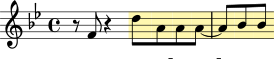
Transcript of a line from The Beatles's 1969 song She Came In Through the Bathroom Window.
Transcript of a line from Billy Joel's 1980 song Close to the Borderline.

Points of connection

  • Both songs are in the key of A and share a single rhythmically-identical pentatonic melody line (highlighted)
  • Phonetically similar lyrics in the same rhythmic positions ("thought I knew"/"think I need", "an[swer]"/"an[ything]")
Style marker
Taylor Swift

Taylor Swift often ends vocal phrases by singing 3̂, dropping to 7̂, then rising to 1̂.
Transcript of a line from Taylor Swift's 2008 song Change.
Transcript of a line from Taylor Swift's 2010 song Back to December.
Transcript of a line from Taylor Swift's 2012 song All Too Well.
Transcript of a line from Taylor Swift's 2012 song The Last Time.
Transcript of a line from Taylor Swift's 2014 song Blank Space.
Transcript of a line from Taylor Swift's 2014 song Clean.
Transcript of a line from Taylor Swift's 2019 song Miss Americana and the Heartbreak Prince.
Transcript of a line from Taylor Swift's 2019 song The Man.
Transcript of a line from Taylor Swift's 2020 song Exile.
Transcript of a line from Taylor Swift's 2020 song Seven.
Transcript of a line from Taylor Swift's 2020 song This Is Me Trying.
Transcript of a line from Taylor Swift's 2020 song 'tis the damn season.
Transcript of a line from Taylor Swift's 2020 song Champagne Problems.
Transcript of a line from Taylor Swift's 2020 song Ivy.
Transcript of a line from Taylor Swift's 2020 song Long Story Short.
Transcript of a line from Taylor Swift's 2022 song Maroon.
Transcript of a line from Taylor Swift's 2022 song Midnight Rain.
Transcript of a line from Taylor Swift's 2022 song Bejeweled.
Transcript of a line from Taylor Swift's 2022 song Karma.
Transcript of a line from Taylor Swift's 2022 song Labyrinth.
Transcript of a line from Taylor Swift's 2022 song Mastermind.
Transcript of a line from Taylor Swift's 2024 song But Daddy I Love Him.
Transcript of a line from Taylor Swift's 2024 song I Can Do It With a Broken Heart.
Transcript of a line from Taylor Swift's 2024 song The Smallest Man Who Ever Lived.
Transcript of a line from Taylor Swift's 2024 song imgonnagetyouback.
Transcript of a line from Taylor Swift's 2024 song So High School.
Transcript of a line from Taylor Swift's 2025 song Elizabeth Taylor.
Transcript of a line from Taylor Swift's 2025 song Ruin The Friendship.
Transcript of a line from Taylor Swift's 2025 song Wi$h Li$t.
Transcript of a line from Nirvana's 1993 song Heart-Shaped Box.
Transcript of a line from Linkin Park's 2000 song By Myself.

Points of connection

  • Both songs are in the key of G# minor and end their chorus on this melodic phrase of identical length, similar rhythm and contour, and many identical notes
  • The chorus in each song strongly accents its second beat on a shouted vocal syllable ("hey" vs. "self")
  • Chester Bennington of Linkin Park has cited Nirvana as a source of inspiration
Style marker
2Pac

2Pac often inserts a single pair of 32nd notes into a line otherwise comprised mostly of 8th and 16th notes.

Transcript of a line from Digital Underground's 1991 song Wussup Wit The Love.
Transcript of a line from 2Pac's 1992 song Changes.
Transcript of a line from 2Pac's 1993 song Representin' '93.
Transcript of a line from 2Pac's 1995 song Heavy In The Game.
Transcript of a line from 2Pac's 1995 song Outlaw.
Transcript of a line from 2Pac's 1995 song California Love.
Transcript of a line from 2Pac's 1996 song Ambitionz Az a Ridah.
Transcript of a line from 2Pac's 1996 song No More Pain.
Transcript of a line from 2Pac's 1996 song All Eyez On Me.
Transcript of a line from 2Pac's 1996 song Can't C Me.
Transcript of a line from 2Pac's 1996 song 2 Of Amerikaz Most Wanted.
Transcript of a line from 2Pac's 1996 song How Do U Want It.
Transcript of a line from 2Pac's 1996 song I Ain't Mad At Cha.
Transcript of a line from 2Pac's 1998 song Troublesome '96.
Transcript of a line from 2Pac's 1996 song Hail Mary.
Transcript of a line from 2Pac's 1996 song To Live And Die In L.A..
Transcript of a line from 2Pac's 1996 song Toss It Up.

He used this technique on his earliest recorded verses as a member of Digital Underground, but they're especially characteristic of his late-career work. It appears on

References in later music

Eminem

Eminem's Soldier uses a pair of 32nd notes in several places, and one accompanying lyric suggests an intentional stylistic reference to 2Pac.

Transcript of a line from Eminem's 2002 song Soldier.
Transcript of a line from Toto's 1978 song Hold the Line.
Transcript of a line from John Siegler & John Loffler's 1999 song Pokémon Theme.
Transposed from G minor.

Points of connection

  • Both songs sing their respective titles on an identical ascending bar-ending three-note phrase: 3̂-5̂-6̂
  • The three-note title phrase's first syllable contains a long "o" vowel, and its third syllable finishes with an "n" sound
  • Both songs begin by comping the tonic chord with a similar keyboard texture
Recurring idea
Yes

The descending melody 6̂-3̂-1̂-7̂, played on a short-short-short-long rhythm, appears in four different Yes songs from the early '70s.

The album Tales From Topographic Oceans also contains musical references to other prior Yes songs.

Transcript of a line from Yes's 1970 song Then.
Transcript of a line from Yes's 1971 song Heart of the Sunrise.
Transcript of a line from Yes's 1972 song Close to the Edge.
Transcript of a line from Yes's 1973 song The Revealing Science of God.

Submitted by @marshmallowturnip. Close to the Edge example contributed by @ed.g00dwin.

Transcript of a line from Duran Duran's 1982 song Hungry Like the Wolf.
Transcript of a line from Michael Jackson's 1991 song Black Or White.

Points of connection

  • The verse of each song starts with a two-bar phrase, starting on the "and" of 1, ending on beat 3 of the second measure, and repeating twice
  • The second measure in each phrase opens by traversing scale degrees 4̂-3̂-4̂-5̂ using eighth notes
  • Both songs are in the same key (E mixolydian)
  • Nick Rhodes of Duran Duran recounted in a 2021 interview that Michael Jackson called him in 1984 to propose a collaboration, but the band declined
Style marker
Kacey Musgraves

Kacey Musgraves evokes a hint of wistfulness at important moments in her songs by singing the 3rd scale degree. She uses 3̂ (or, less often, 5̂) to punctuate a key phrase, especially a line including the song's title, in places where resolution to the tonic would otherwise be expected.

This device is most strongly associated with country music: see e.g. Jim Croce's Operator (1972) and Tim McGraw's Can't Tell Me Nothin' (2004).

In Kacey Musgraves' catalogue, the frequency of phrase-ending 3̂s peaks on 2018's Golden Hour, after which she deploys them more sparingly.

Transcript of a line from Kacey Musgraves's 2013 song Silver Lining.
Transcript of a line from Kacey Musgraves's 2013 song My House.
Transcript of a line from Kacey Musgraves's 2013 song Merry Go Round.
Transcript of a line from Kacey Musgraves's 2013 song Dandelion.
Transcript of a line from Kacey Musgraves's 2013 song Follow Your Arrow.
Transcript of a line from Kacey Musgraves's 2015 song Die Fun.
Transcript of a line from Kacey Musgraves's 2016 song Christmas Makes Me Cry.
Transcript of a line from Kacey Musgraves's 2018 song Slow Burn.
Transcript of a line from Kacey Musgraves's 2018 song Butterflies.
Transcript of a line from Kacey Musgraves's 2018 song Mother.
Transcript of a line from Kacey Musgraves's 2018 song Love Is A Wild Thing.
Transcript of a line from Kacey Musgraves's 2018 song Space Cowboy.
Transcript of a line from Kacey Musgraves's 2018 song Golden Hour.
Transcript of a line from Kacey Musgraves's 2021 song Cherry Blossom.
Transcript of a line from Kacey Musgraves's 2024 song Moving Out.
Transcript of a line from Kacey Musgraves's 2024 song Heart of the Woods.
Transcript of a line from The Beatles's 1967 song Penny Lane (bassline).
Shown in treble clef for comparison.
Transcript of a line from Paul McCartney's 1979 song Wonderful Christmastime.
Style marker
'90s & '00s pop rock

Many pop-rock songs from the '90s and early '00s create a lingering unresolved feeling by including the 4th scale degree in their final chord.

Sometimes it's the root of a IV chord, but it can also be the 5th of the bVII chord.

Transcript of a line from Gin Blossoms's 1992 song Hey Jealousy.
Transcript of a line from Gin Blossoms's 1992 song Found Out About You.
Transcript of a line from Matchbox Twenty's 1996 song 3AM.
Transcript of a line from Blink 182's 1999 song What's My Age Again?.
Transcript of a line from American Hi-Fi's 2001 song Flavor of the Weak.
Transcript of a line from Michelle Branch's 2001 song All You Wanted.
Transcript of a line from Michelle Branch's 2003 song Breathe.
Transcript of a line from Yellowcard's 2003 song Ocean Avenue.
Transcript of a line from The Click Five's 2005 song Just The Girl.
Transcript of a line from Taylor Swift's 2012 song Stay Stay Stay.
Transcript of a line from Lorde's 2017 song Supercut.

Points of connection

  • A seven-note sequence, sung on the same rhythm, in the same part of the bar, and in the same key (C)
  • Supercut contains an additional melodic reference to another Taylor Swift song (Out of the Woods)
Transcript of a line from Taylor Swift's 2014 song Out of the Woods.
Transcript of a line from Lorde's 2017 song Supercut.

Points of connection

  • These lines are sung on a similar lyric in the same bar position: starting on the "and" of 3 and ending on the following measure's third beat. The word "a" appears in the same position, and both lines end with "of us."
  • The same melodic contour
  • Supercut contains an additional melodic reference to another Taylor Swift song (Stay Stay Stay)
Style marker
Caroline Polachek

Caroline Polachek sings a lot of wide melodic leaps, including frequent fourths and fifths, but she's especially well-distinguished by how often she sings the minor 6th interval. It's uncommon in pop vocals at large, but common in her work.

It doesn't appear on Chairlift's first album, but becomes increasingly common starting with 2019's Pang.

Transcript of a line from Chairlift's 2012 song Amanaemonesia.
Transcript of a line from Chairlift's 2012 song Take It Out On Me.
Transcript of a line from Chairlift's 2016 song Show U Off.
Transcript of a line from Caroline Polachek's 2019 song The Gate.
Transcript of a line from Caroline Polachek's 2019 song New Normal.
Transcript of a line from Caroline Polachek's 2019 song Look At Me Now.
Transcript of a line from Caroline Polachek's 2019 song Hey Big Eyes.
Transcript of a line from Caroline Polachek's 2019 song Go As A Dream.
Transcript of a line from Caroline Polachek's 2019 song Door.
Transcript of a line from Caroline Polachek's 2023 song Welcome To My Island.
Transcript of a line from Caroline Polachek's 2023 song Pretty In Possible.
Transcript of a line from Caroline Polachek's 2023 song Sunset.
Transcript of a line from Caroline Polachek's 2023 song I Believe.
Transcript of a line from Human League's 1981 song Don't You Want Me.
Transcript of a line from Charli XCX's 2024 song Apple.
Style marker
Andrew McMahon

Andrew McMahon of Jack's Mannequin and Something Corporate often ends vocal phrases by singing 1̂, rising to 5̂, then dropping to 3̂. He's not the only one -- e.g., Taylor Swift uses this cadence sometimes -- but he does it surprisingly often, throughout his career, and with little regard for the underlying harmony.

Transcript of a line from Something Corporate's 2002 song Walking By.
Transcript of a line from Something Corporate's 2003 song Only Ashes.
Transcript of a line from Something Corporate's 2003 song As You Sleep.
Transcript of a line from Jack's Mannequin's 2005 song Dark Blue.
Transcript of a line from Jack's Mannequin's 2005 song Bruised.
Transcript of a line from Jack's Mannequin's 2005 song Kill the Messenger.
Transcript of a line from Jack's Mannequin's 2005 song Rescued.
Transcript of a line from Jack's Mannequin's 2005 song Made For Each Other.
Transcript of a line from Jack's Mannequin's 2005 song I'm Ready.
Transcript of a line from Jack's Mannequin's 2008 song What Gets You Off.
Transcript of a line from Jack's Mannequin's 2008 song Suicide Blonde.
Transcript of a line from Jack's Mannequin's 2008 song The Resolution.
Transcript of a line from Jack's Mannequin's 2008 song Caves.
Transcript of a line from Jack's Mannequin's 2011 song Release Me.
Transcript of a line from Jack's Mannequin's 2011 song People, Running.
Transcript of a line from Andrew McMahon's 2014 song Cecilia and the Satellite.
Transcript of a line from Andrew McMahon's 2014 song See Her On The Weekend.
Transcript of a line from Andrew McMahon's 2023 song VHS.
Transcript of a line from Dave Matthews Band's 1994 song Satellite.
Transcript of a line from John Mayer's 2009 song Edge of Desire.
Transposed from Eb.

In 2017 on Instagram Live, John Mayer described the guitar riff from Edge of Desire as "not that different from Satellite."

In 2025 on his Sirius XM radio station, he also recounted that as a teenager he'd practiced using a four-track recorder by recording layered guitar parts from Satellite.

Transcript of a line from Simon and Garfunkel's 1968 song Mrs. Robinson.
Transcript of a line from One Direction's 2014 song Girl Almighty.

Points of connection

  • These songs share a rhythmically and lyrically identical 4̂-3̂-2̂ melody in the key of A major
  • Girl Almighty contains substantial material from another Paul Simon song (The Obvious Child)
Transcript of a line from John Lennon's 1968 song Happiness is a Warm Gun.
Transcript of a line from Michelle Branch's 2003 song 'Til I Get Over You.

These songs share

  • The key of E minor
  • Verse melodies that alternate 2̂ and 3̂ in a similar rhythmic pattern
  • Lyrical reference to a gun, unusual in the work of Michelle Branch
Transcript of a line from SZA's 2017 song Love Galore.
Transcript of a line from Taylor Swift's 2025 song Wi$h Li$t.
Transposed from C.

Similarities

These songs share a repeating series of six intervals in similar metric positions, each ending on the word "want."

Style marker
Early '90s hip hop

Many hip hop and R&B songs from the '90s and late '80s feature percussion swung at the 16th-note level. In this context, when a rapper articulates 16th-note triplets, it creates a distinctive sound commonly associated with Das EFX.

It fell out of popular use by the latter half of the decade.

Transcript of a line from Jaz-O's 1989 song Dance To This.
Transcript of a line from Digital Underground's 1990 song Doo Woo You.
Transcript of a line from Das EFX's 1992 song They Want EFX.
Transcript of a line from Original Flavor's 1993 song Can I Get Open?.
Verse by Jay-Z.
Style marker
Paul Simon

Paul Simon achieves a folky quality in his melodies by descending stepwise from 2 to 1, then leaping up to 3 and descending stepwise to 1 again: 2-1-3-2-1.

Often, but not always, this pattern is preceded by an additional 3: altogether, 3-2-1-3-2-1.

Transcript of a line from Paul Simon's 1972 song Me and Julio Down by the Schoolyard.
Transcript of a line from Paul Simon's 1973 song Kodachrome.
Transcript of a line from Paul Simon's 1973 song Learn How to Fall.
Transcript of a line from Paul Simon's 1973 song Was a Sunny Day.
Transcript of a line from Paul Simon's 1975 song You're Kind.
Style marker
Ben Folds
[...] there is a certain vocal gesture used by singer-songwriter Ben Folds [...] that tends to occur at the ends of phrases (scale degree 5̂ falls to 3̂, and then leaps up to 6̂). It may seem like a coincidence, [...] but in Ben Folds Five’s cover of the Buggles’ classic "Video Killed The Radio Star" [...] Folds interpolates the 5̂-3̂-6̂ gesture at the end of a phrase that, in the original version, was simply a repeated dominant tone.

Nathaniel Adam, Coding OK Computer (2011)

Transcript of a line from The Buggles's 1979 song Video Killed The Radio Star.
Transcript of a line from Ben Folds Five's 1997 song Video Killed The Radio Star.

5̂-3̂-6̂ in original songs by Ben Folds

Transcript of a line from Ben Folds Five's 1995 song Julianne.
Transcript of a line from Ben Folds Five's 1995 song Eddie Walker.
Transcript of a line from Ben Folds Five's 1995 song Where's Summer B..
Transcript of a line from Ben Folds Five's 1995 song Video.
Transcript of a line from Ben Folds Five's 1997 song Kate.
Transcript of a line from Ben Folds Five's 1997 song Fair.
Transcript of a line from Paramore's 2007 song Misery Business.
Transcript of a line from Taylor Swift's 2010 song Better Than Revenge.
Transposed from D.

These songs share

  • The first and third measure of their intro guitar riffs (shown)
  • A lyrical theme and some similar phrases ("I got him where I want him now" vs "I had him right there where I wanted him")
Transcript of a line from Paramore's 2007 song When It Rains.
Transcript of a line from Taylor Swift's 2010 song Better Than Revenge.

These lines have identical lyrics, an identical rhythm, and share four of their seven pitches.

Transcript of a line from Paramore's 2007 song That's What You Get.
Transcript of a line from Taylor Swift's 2010 song Better Than Revenge.
Transposed from D.

The choruses of these songs

  • Start their first two measures on a high 5̂
  • Share identical rhythmes for the first measure and a half
  • End their first phrase with a high melisma on 3̂-6̂-5̂, sung on "whoa"

Taylor Swift and Hayley Williams sang That's What You Get together at a concert in September 2011.

Style marker
Late '90s pop

In the late '90s and early '00s, pop songs often used the leading tone in a minor key (i.e., the note one half-step below the tonic), along with the V7/vi dominant chord to which it belongs.

Transcript of a line from Backstreet Boys's 1997 song Everybody.
Transcript of a line from Britney Spears's 1999 song Crazy.
Transcript of a line from Christina Aguilera's 1999 song Genie in a Bottle.
Transcript of a line from *NSYNC's 2000 song It's Gonna Be Me.

Ancestors

There is [...] a tradition of pure [i.e., "harmonic"] minor modality, blues aside, in the R&B music of Stevie Wonder and Michael Jackson; this is the heritage of the Backstreet Boys.

Walter Everett, "Pitch Down the Middle", from Expression in Pop-Rock Music (2008), p. 172

Transcript of a line from Stevie Wonder's 1972 song Superstition.
Transcript of a line from Michael Jackson's 1987 song Smooth Criminal.

References in later music

Meghan Trainor

Time Magazine: Were there any artists you were thinking about as reference points while creating [the 2016 song No]?

Meghan Trainor: Obviously we wanted that '90s feel that everybody loves and recognizes and misses.

Time Magazine, 2016

Transcript of a line from Meghan Trainor's 2016 song No.
Eminem

Despite Eminem's outspoken disdain for the boy bands of the '90s, many of his early songs inherited the harmonic minor scale from those very bands.

An anti-Backstreet and Ricky Martin
Whose instinct's to kill *NSYNC, don't get me started
Those fuckin' brats can't sing, and Britney's garbage

Eminem, Marshall Mathers (2000)

Transcript of a line from Eminem's 2000 song Kill You.
Transcript of a line from Eminem's 2000 song Marshall Mathers.
Transcript of a line from Eminem's 2002 song Cleanin' Out My Closet.
Transcript of a line from Eminem's 2002 song Till I Collapse.
Style marker
'70s-'80s hip hop

It was common in the 1970s and '80s to end a rap line with this rhythmic figure on the third beat of a measure:

Notation in which the third beat articulates three of its four sixteenth notes, omitting the third.

It fell out of favor by the early '90s.

Transcript of a line from Kurtis Blow's 1980 song Basketball.
Transcript of a line from Run-D.M.C.'s 1986 song My Adidas.
Transcript of a line from Eric B. & Rakim's 1988 song Microphone Fiend.

References in later music

The Pharcyde

The Pharcyde's 1992 song Return of the B-Boy, which opens with the lyric "yo, is '87 in the house," uses this rhythm to imitate the sound of the '80s.

Transcript of a line from The Pharcyde's 1992 song Return of the B-Boy.
Style marker
Billy Joel

Several Billy Joel songs from the mid-'70s contain a similar rhythmic pattern: he sings a dense sequence of sixteenth or eighth notes, with a note onset on all subdivisions but the first in each group of four.

Transcript of a line from Billy Joel's 1976 song Angry Young Man.
Transcript of a line from Billy Joel's 1977 song Anthony's Song (Movin' Out).
Transcript of a line from Billy Joel's 1977 song Scenes From An Italian Restaurant.
Style marker
Bob Dylan

Bob Dylan adds a tender, vulnerable quality to many of his phrases by ending on 4 over a I chord with which it does not agree; this [...] is so frequently heard [...] that it might be referred to as the Dylan cadence.

Walter Everett, The Foundations of Rock (2009), p. 186

Transcript of a line from Bob Dylan's 1965 song Like a Rolling Stone.
Transcript of a line from Bob Dylan's 1965 song Just Like Tom Thumb's Blues.
Transcript of a line from Bob Dylan's 1966 song Visions of Johanna.
Transcript of a line from Bob Dylan's 1966 song Absolutely Sweet Marie.
Transcript of a line from Bob Dylan's 1975 song If You See Her, Say Hello.
Style marker
Ghostface Killah

In the early '90s, Ghostface favored a sequence of three rhythms, always appearing together in the same bar:

  1. 2-3 syncopated eighth notes
  2. the last three sixteenth notes of the third beat
  3. a single-syllable rhyme on the fourth beat
Transcript of a line from Ghostface Killah's 1993 song 7th Chamber.
Transcript of a line from Ghostface Killah's 1993 song Can It Be All So Simple.
Transcript of a line from Ghostface Killah's 1996 song Guillotine.
Transcript of a line from Ghostface Killah's 1996 song Motherless Child.
Transcript of a line from Ghostface Killah's 1996 song All That I Got Is You.
Style marker
Little Richard

Little Richard made famous the registral isolation of a single tone in falsetto [...]. Richard would usually break his voice to arrive on a high 1̂ [...].

Walter Everett, The Beatles as Musicians (2001), p. 73

Transcript of a line from Little Richard's 1955 song Tutti Frutti.
Transcript of a line from Little Richard's 1955 song True Fine Mama.
Transcript of a line from Little Richard's 1955 song Long Tall Sally.
Transcript of a line from Little Richard's 1955 song Good Golly Miss Molly.
Transcript of a line from Little Richard's 1955 song Keep a Knockin'.

References in later music

Paul McCartney

[Little Richard] would say, 'I taught Paul everything he knows'. [...] I had to admit he was right.

Paul McCartney, Twitter (2020)

Transcript of a line from The Beatles's 1969 song Oh Darling.
Style marker
Taylor Swift

Swift has her own melodic signature [...]: a three-note melodic motif [usually descending from 4̂ to 3̂ and then to 6̂] that we've termed the "T Drop."

Nate Sloan & Charlie Harding, Switched On Pop (2020), p. 22

It first appears in You Belong With Me (2008) and is a consistent feature of her writing since then.

Transcript of a line from Taylor Swift's 2008 song You Belong With Me.
Transcript of a line from Taylor Swift's 2010 song Mean.
Transcript of a line from Taylor Swift's 2010 song Innocent.
Transcript of a line from Taylor Swift's 2012 song State of Grace.
Transcript of a line from Taylor Swift's 2012 song All Too Well.
Transcript of a line from Taylor Swift's 2012 song Begin Again.
Transcript of a line from Taylor Swift's 2022 song You're On Your Own, Kid.
Transcript of a line from Taylor Swift's 2022 song Labyrinth.
Transcript of a line from Taylor Swift's 2024 song The Tortured Poets Department.
Transcript of a line from Taylor Swift's 2025 song Father Figure.
Transcript of a line from Ludwig von Beethoven's 1807 song Sonantina in F Major.
Transcript of a line from Billy Joel's 1977 song Anthony's Song (Movin' Out).

The sequence [that opens the chorus of Movin' Out] is heard untransposed [...] in the F-major Sonatina ascribed by Thayer to Beethoven's Bonn period (first movement, mm. 35-38).

Walter Everett, 2000. "The Learned vs. The Vernacular in the Songs of Billy Joel". Contemporary Music Review, 18(4).

Transcript of a line from Kim Carnes's 1981 song Bette Davis Eyes.
Transcript of a line from Caroline Polachek's 2019 song So Hot You're Hurting My Feelings.
I was really inspired by that synth riff in that song “Betty Davis Eyes.”

Caroline Polachek, interview with genius.com, 2020

The verses in both songs alternate one-bar phrases between two voices, emphasizing the second eighth note in each measure.

Transcript of a line from Jimmy Eat World's 1999 song Ten.
Transcript of a line from Paramore's 2007 song When It Rains.
Transposed from Eb.

These songs share

  • A section comprised of three notes, one per measure, with two voices in harmony, where one voice descends from 3̂ to 2̂ to 1̂
  • A snare drum pattern that accents the second eighth note of the third beat in each measure
  • The long "A" vowel on the first syllable
Transcript of a line from Paul Simon's 1990 song The Obvious Child.
Transcript of a line from One Direction's 2014 song Girl Almighty.
Transposed from A.

These songs share

  • Phonetically similar words ("had"/"have", "money"/"mighty", "son"/"young") occur in the same rhythmic locations (underlined)
  • Two measures of unaccompanied lyrics alternate with two measures of rhythmically and harmonically similar guitar chord stabs
  • The highlighted sections of melody are identical
Transcript of a line from Paul McCartney's 1980 song Waterfalls.
Transcript of a line from TLC's 1994 song Waterfalls.
Transposed from Eb.

These songs share

  • A lyric
  • A sequence on the word "waterfalls" that descends from 7̂ to 6̂ and then to 5̂ (though the 7̂ is flat in McCartney's case)

AV Club: TLC ripped off Paul McCartney? I had no idea!

Paul McCartney: I think so.

AV Club interview (2007)

Transcript of a line from Sixpence None the Richer's 1997 song Kiss Me.
Transcript of a line from SZA's 2022 song F2F.
Transposed from D.

Similarities

They share a three-note sequence, each located at the end of its phrase: 2̂ rises to 3̂, then drops to 5̂.

SZA performed Kiss Me in concert six times in 2019.